
Glycine and Healthy Ageing: Why This Small Amino Acid Is Getting More Attention
· 5 min read
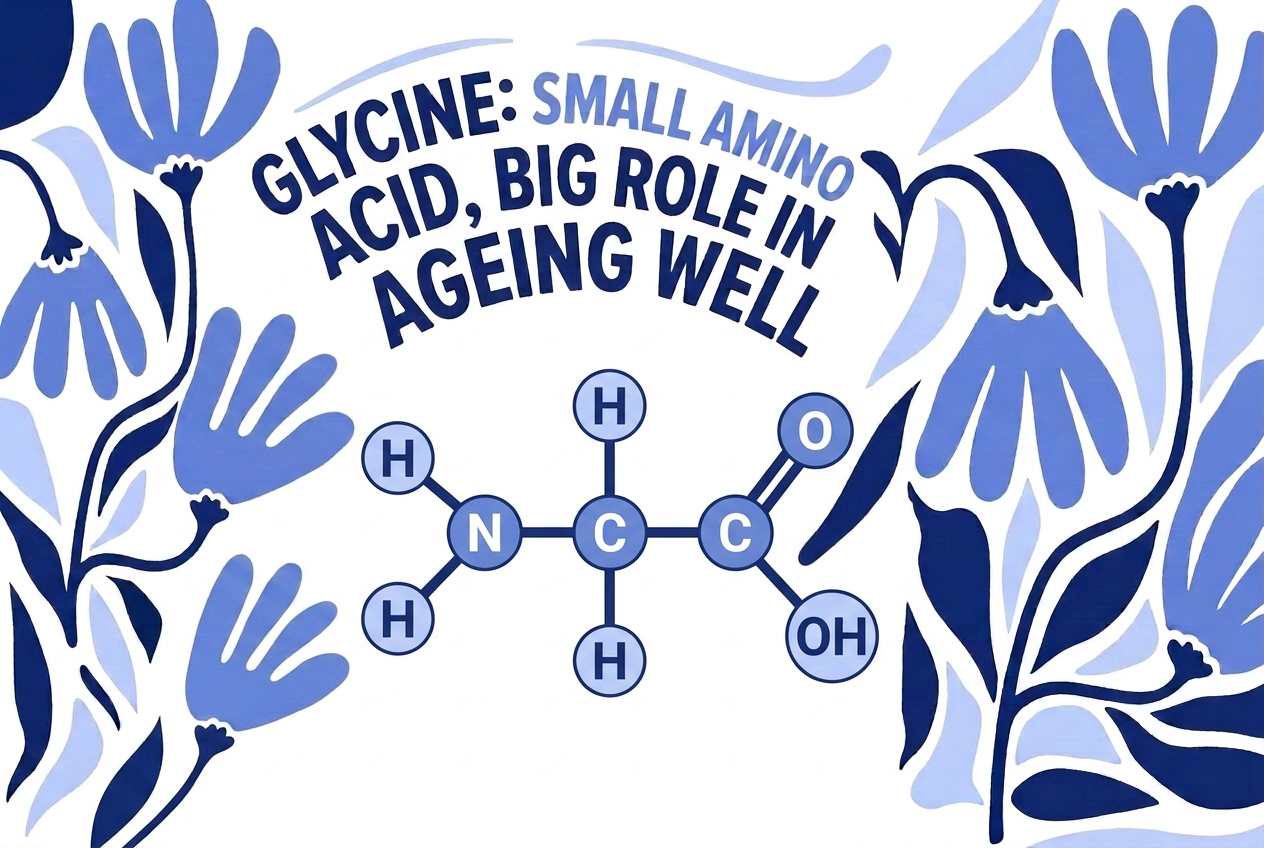
What is glycine and why is it so important?
Glycine is the smallest and simplest amino acid in our body. Even though its structure is very simple, it is essential for life. It makes up one-third of collagen, the protein that keeps our skin, joints, and bones strong. It is also the main ingredient needed to produce glutathione, the body's most powerful antioxidant that protects cells from ageing. On top of that, glycine boosts muscle creatine production and works as a key brain chemical (neurotransmitter) to calm and balance the nervous system.
How does our body produce it?
Glycine is classified as a "non-essential" amino acid because our body can produce it naturally. However, this internal production only covers about 35% of what we actually need; the rest must come from our diet (around 1.5 to 3 grams per day). Although glycine is found throughout the body, its levels in the blood tend to drop significantly as we get older or when we experience long-term inflammation.
Why does glycine support longevity?
Recent research shows that glycine does much more than just build body structures: it sends signals to cells to activate their natural defense and longevity systems through three main mechanisms:
- It activates the cell's recycling system: As we age, cells collect waste and damaged parts. Glycine activates a process called autophagy, which is the cell's way of cleaning up its own waste, breaking it down, and recycling it to build new, healthy parts.
- It revitalises cellular energy: Mitochondria are the internal powerhouses that produce energy for the body. Glycine helps restart these powerhouses when they lose efficiency over time, supporting cell repair and boosting energy in key organs like the brain and muscles.
- It fights chronic inflammation: As time goes by, a low-level, invisible inflammation slowly wears down our tissues. Glycine acts like a fire extinguisher: it turns off the "switch" that creates this inflammation and helps the body produce glutathione, our strongest natural antioxidant.
What does the scientific evidence say?
In animal studies
Research on animal models shows that glycine not only extends life, but also helps maintain a better quality of life. In studies by the US National Institute on Aging, glycine supplements increased the lifespan of both male and female mice while protecting them against lung tumors. Similarly, in studies with rats, flies, and worms, glycine increased survival by up to 28% in simple organisms. It also helped older animals maintain better muscle strength, preserve muscle mass, and reduce damage to memory neurons.
In humans
Although there are no studies directly proving that taking glycine alone extends human life, clinical trials show clear improvements in functional and metabolic health:
- Better sleep and daytime energy: In healthy adults, taking 3 grams of glycine before bed improves sleep quality and reduces fatigue the next day.
- Metabolic and heart health: In patients with type 2 diabetes or metabolic syndrome, glycine helps improve insulin sensitivity, regulate blood sugar levels, and lower systolic blood pressure.
- The GlyNAC trial (Glycine + N-Acetylcysteine): In a 16-week clinical trial with older adults, combining glycine with N-acetylcysteine fixed glutathione deficiency. This intervention improved 7 key signs of ageing, helping participants build muscle strength, walk faster, and reduce waist size.
Conclusion
Glycine is far more than a simple amino acid: it plays a central role in the mechanisms of cellular repair, energy, and youthfulness. Enhancing glycine levels in the body stands as one of the most promising and evidence-based nutritional strategies for promoting healthy aging.
Sources
- Glycine: the smallest anti-inflammatory micronutrient (2023). International Journal of Molecular Sciences, 24, 11236. https://pmc.ncbi.nlm.nih.gov/articles/PMC10379184/pdf/ijms-24-11236.pdf
- Johnson, A. A., Cuellar, T. L. (2023). Glycine and aging: Evidence and mechanisms. Ageing Research Reviews, 87, 101922. https://doi.org/10.1016/j.arr.2023.101922
- Kumar, P., et al. (2022). Supplementing glycine and N-acetylcysteine (GlyNAC) in older adults: a randomized clinical trial. The Journals of Gerontology Series A, 78(1), 75–89. https://doi.org/10.1093/gerona/glac135
- Quintanilla-Villanueva, G., et al. (2024). The role of amino acid glycine on cardiovascular health: a narrative review. Journal of Vascular Diseases, 3(2), 201–211. https://doi.org/10.3390/jvd3020016
- Miller, R. A., et al. (2019). Glycine supplementation extends lifespan of male and female mice. Aging Cell, 18(3), e12953. https://doi.org/10.1111/acel.12953
- Soh, J., et al. (2023). The effect of glycine administration on physiological systems in human adults: a systematic review. GeroScience, 46(1), 219–239. https://doi.org/10.1007/s11357-023-00970-8
- Yu, J., et al. (2026). Glycine ameliorates aging-related dysfunctions associated with Nmdmc-mediated mitochondrial one-carbon metabolism. Free Radical Biology and Medicine, 697–710. https://doi.org/10.1016/j.freeradbiomed.2026.01.050